FOR NEW iconographic reading of the sanctuary of Holy Cross of San Miniato (first part) Francesco Fiumalbi
Anything that has to do with SS Crucifix (called "Castelvecchio") in San Miniato has a special aura. From the legend of his recovery at the desire to build the council hall of the "People's Palace" at the end of '200 on the Oratory who guarded it (today known as the "Oratory of Loretino). By the companies of "Whites" who wielded the processions, the ancient Society of the Holy Cross which still exists today (1). Even the urban environment within which lies the shrine that has "charisma".
We will say at once that the real church and the wooden statue in it, we'll deal with in an appropriate intervention. In this we will make a summary of events that led to the building of the complex (church + staircase) and, according to the tradition began in 1631. Then go deep into what has been said in books and publications relating to its urban layout and its possible meanings iconography. To this end it is worth remembering that the City of San Miniato had won the seat of the Diocese only a few years earlier (2), in 1622, es'imponeva a renewal of religious buildings unfit for the role that a citizen that extraterritorial were called upon to play.
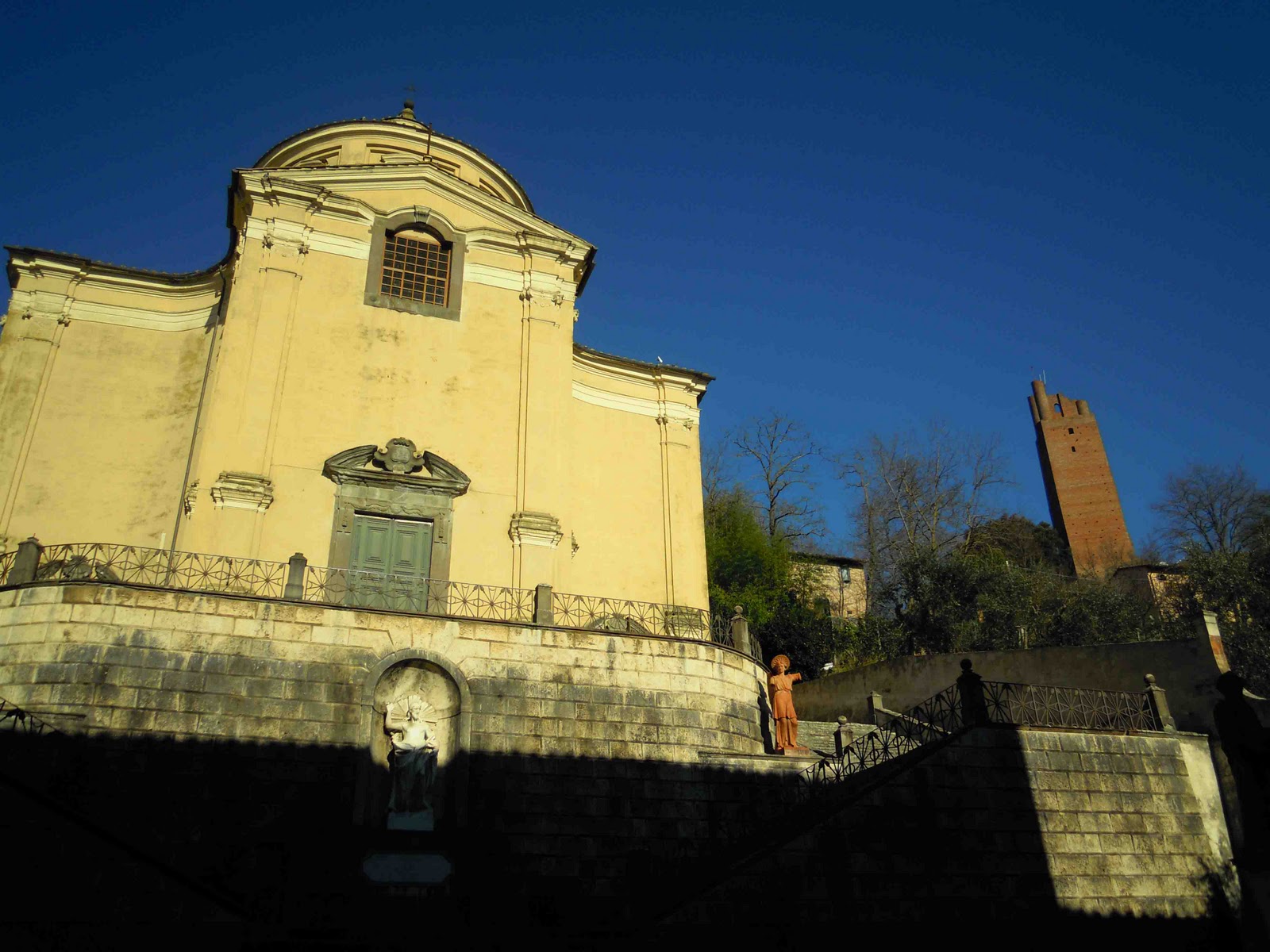
The Shrine of the Holy Cross Castelvecchio
Photo by Francesco Fiumalbi
The population of San Miniato had turned with hope and devotion to the "miraculous" statue during the difficult years from 1628 to 1631, marked by the scourge of plague. Just goes back to 1631 because the famous "vote" which would have resulted in the construction of the new sanctuary, as thanksgiving and renewed devotion to the sacred image of Jesus Crucified, by which the population would have been spared by yet another outbreak.
Construction began a full 74 years later, in 1705, thanks to Bishop Poggi who broke through the inertia on the dissolution of the "vote". The new sanctuary was designed by architect and engineer Antonio Ferri Florentine, who also supervised the construction management. Worked within the Florentine painter Domenico Antonio Bramberini (3). The new church was inaugurated on July 26, 1718 and consecrated by Archbishop Cattani May 3, 1729. The story of the building, as well as other documents relating to 'Opera SS. Crucifix , preserved in the Archives of the Diocese of San Miniato, talk about it in Memoirs of the Oratory of the Sacred Image of the Holy Cross and that of Castel-old , written by the 'Worker "and" Party Animal Bernardo Morales, in 1755, and published in the Bulletin of the Academy of Euteleti No 45, 1976, in an operation supervised by Anna Matteoli.
First, the appointed place to welcome the new sanctuary was demolished the spur of the hostel where there was visited by pilgrims, the statue was delivered angels (4). So all in accordance with the tradition of San Miniato.
The land on which the building would rise initially had a garden adjacent to the Palazzo dei Priori, this initial hypothesis was lost when the architect Poggi suggested the current site to give the building more "magnificence" and " decorum "(5). The choice then fell on a portion of the slope which was acquired by the Donati family-Markets, the owner since the sixteenth century of the "hill" of the Rock, bought by Bishop Michele Mercati, and turned it into a garden-botanical garden (6).
The Shrine of the Holy Crucifix Castelvecchio
Photo by Francesco Fiumalbi
also known as the Christian Texts (7), a building of this kind, with plan to "Greek cross" could not fit in the alignment of the medieval street, now Via del Duomo Victims. The solution adopted was to back the building from the roadway. This caused the difficulty of the jump altitude of 10 meters, which was solved through the inclusion of the steps. In this way the scheme was to break the Middle Ages, they built a vacuum filled by the formation of the fifth consists of the urban scale and the shrine, repeating patterns and their prospective models of traditional urban renaissance and baroque twist. The Christian Texts argues his speech to dwell at length on aspects "kinesthetic", especially given the way the horizontal movement and vertical proposed by the stairs, different visions of the same "scene" in perspective, front view, and then again for a long down and slowly upwards (8).
This urban environment has been treated by the designer as a theatrical backdrop. The same Antonio Ferri, in correspondence with the Bishop Poggi, to define all of the Sanctuary uses the word "machine", a term borrowed from the jargon just a designer. The iron, on the other hand had gained experience of stage production, especially in the villa of Pratolino on behalf of the family of "builders of theaters" Galli-Bibiena (9).
The original arrangement of the connection between the building elevation and the road was not exactly that today. Important work was carried out during the ''800 and there is a summary of the Simoncini (10):
"The grand staircase, only in principle, divides into two ramps on the first floor for access to a higher plateau on which open the main gate of the shrine and the two sides, was designed and built by Ferri. This magnificent staircase that is reminiscent of Roman Trinita dei Monti, rises above street level of 10 meters, is in stone, with the draft that support the side ramps and central terrace travertine. Accompanied by an artistic iron railings ramps and close the balcony. Bozzato and railing were inaugurated in 1867 and on that occasion were placed in the niche the "Risen Christ" by Bernini of a Franciscan friar who had carved in 1723 (located so far on the high altar of the church of San Francesco, ed) and, at the center shelf, the two angels of the famous Florentine sculptor Luigi Pampaloni. Instead, they were inaugurated in 1888 the statues of the apostles Peter and Paul, who, while having no artistic value, contributing to increasing the dignity and harmony of the steps of the Temple. "
So the completion of the arrangement of the steps took place in two stages. The first, eighteenth century saw the construction of the ramp, perhaps with the current "arms", as suggested by the depiction of San Miniato on the cover of the Proceedings of Synod, held in 1707 and still showing the building in the "octagonal" (11). The later nineteenth century saw the creation instead of ashlar finish, the positioning of the balustrade and placement apparatus sculpture.
The problem that arises at this point is whether the two moments belong to the same iconographic design, or if this is changed between 700 and 800. In the above cover image of the Acts of the Synod of 1707, we appreciate the presence in the design of a niche, positioned exactly where it is today and that more or less the same size. It seems that the operations are only a sort of nineteenth-century re-styling to give greater dignity in urban offered by the Sanctuary with its completion iconographic apparatus. In short, the design of urban layout of the Oratory had to be mature from the start, but was completed only in 1867, a definitive, well 149 years after the inauguration of the church.
Steps of the Shrine of the Holy Cross
Photo by Francesco Fiumalbi
As we know all the sacred works of art, whether paintings, sculptures, architecture, music, etc., are never the result of chance. There is always a meaning, a common thread, a reference to Scripture or to experiences and episodes from the Christian tradition. It is no coincidence that since the Council of Trent, the penalty became increasingly close and work was recognized the increasing importance of narrative and communicative. The Shrine of the Holy Cross should have a precise iconography; of This speaks of it Vens Antonio (12):
"The architect Monsignor Poggi iron in two designs, a roundabout and a cross, but the bishop chose the second design, so that the oratory resembles that that after the victory of Constantine towered the peaks of Mount Calvary. The Oratory is then molded on the emblem of redemption with equilateral arms (...) ".
Maria Adriana Giusti also states that local historians have attributed to the shape of the Sanctuary not only the iconographic value of relic but also memory of the place of Christ's crucifixion, with obvious reference to the type of the Holy Sepulchre, recalling the shapes of martyrium Byzantine culture, identified with the shape of the cross (13).
How many of you have certainly noticed the words of Vens are completely wrong. The Basilica of the Holy Sepulchre, built at the behest of Constantine on the site of Calvary was not with "equilateral arms." To be precise it was three bodies: the "Basilica", a "Hall" column that is above the Holy Sepulchre and the famous "Round". No mention of a plan to "cross Greek. " Among other things, the most "copied" the complex of the Basilica of the Holy Sepulchre is precisely the "Round" which probably made a model of the Baptistery of Pisa. (To explore the theme of the Basilica of the Holy Sepulchre see Wikipedia ) short, the Shrine of the Holy Cross of Castelvecchio is not anywhere near relative of the Basilica of the Holy Sepulchre in Jerusalem. Probably the original plan, the "round", it actually inspired the building of Constantine, but not the version chosen by the Bishop Poggi. And if it is true that the Byzantine martyrium , implicated in the Giusti, they were actually "Greek cross" is because they are derived, not from the Basilica of the Holy Sepulchre, but the Church of Saints Constantine called Apostoleion (see Wikipedia) , built in Constantinople, now Istanbul, and originally conceived as the imperial mausoleum. The church considered more verosimigliante to ' Apostoleion is the San Marco in Venice. In short, the planimetric approach can also be similar to the sanctuary of San Miniato, but not its vertical development in the reconstruction of the Constantinian basilica through the study of the Venetian model, it was made with 5 domes, with a narthex that separated the real church from the outside, connected by a kind of sacred enclosure. These hypotheses are convincing to a certain point.
As mentioned the building is a "central plan" to form the so-called "Greek cross" with a hemispherical dome. References to the construction of Christian churches with this site plan are many. We're not going to list them all, and we apologize for any inaccuracies, we want to focus attention to the fact that such churches usually emphasize the connection between Heaven and Earth. The "Greek cross" of the plant is part of a square, a symbol of land, that forms the matrix. E 'consists of four arms, four elements land, the four virtues of man, the four cardinal points. The center of the plant is also the center of the dome, which is hemispherical and instead refers to the celestial world, the centrality of Christ in the cosmos and authentic with the cardinal points (14). In short, a "bridge" between earth and sky, a sort of "ladder" to climb towards God
The Shrine of the Holy Cross of San Miniato
Photos of Francis Fiumalbi
The same right to say that "... the prospective link between the city and its temple - the center of the visual composition -" arises " in a symbolic, as the 'Via Crucis', processional route designed to commemorate the route that leads to Christ's cross, until the culminating moment of his sacrifice, and then his resurrection; key in the Gospels, the translation of the 'royal road' that is available to 'the saved "and that connects' the city of man 'with the Augustinian' city of God '(...). " (15).
One can hardly explain the placement of the statue of the Risen Christ in the niche at the foot of the slope, if the church becomes a symbol of death and resurrection of Christ. Especially as the stairway can act as a "Via Crucis" where the climax, the addition fifteenth station, the Resurrection is located at the beginning and not at the end? So if one part is true that refers to the steps related to certain ceremonial SS Crucifix, characterized by processional routes is also true that he would face a joint narrative inconsistent. Simply put, how many times resurrected Christ in the Via Crucis ?
Risen Christ
Steps of the Shrine of the Holy Crucifix
Photo by Francesco Fiumalbi
Someone, Indeed, saying that the syndicate could Risen Christ there has been placed almost a century and a half later, and then the setting will be consistent. However, the same Giusti said shortly after (16):
" The route marked by the vertical line on which, in ascending sequence, the statues of angels and the four evangelists, the temple door, the lantern and the lantern, marks the sites commemorating the gap between the two civitas. The use of single path (...) which follows a liturgical director, announced the outside through the symbolic ascent, culminating in the altar where the sacred image is kept .
In footnote 26, attached to the aforementioned text, the right argues that the statues (within the evangelists, ed) were placed only in 1845 , but the arrangement of niches inside and outside spaces suggest that the project, so minutely defined, understood the architecture with its accompanying statuary. Then as we know the statues of angels and the Risen Christ were placed a few years later, in 1867. So the two, one.
If the original plan a different system of sculptures that has been redefined in the '800 is a stretch to iconography. Conversely, it is much more likely, as we said earlier, that from the beginning it had very clear idea iconographic be attributed to the church, the orchestration and the fifth urban sculpture. As we have seen, the interpretations made so far do not seem entirely convincing. They are for parties, but when joined together constitute something incoherent. So, what meaning could have the Sanctuary of SS. Crucified?
In the second part of this paper will discuss, however, an iconography that our hypothesis was suggested by Don Luciano Marrucci and that appears to be consistent with the city planning and the sculptural apparatus.
References
(1) Vasco Simoncini, the Castelvecchio The crucifix in the history and life of San Miniato , Edizioni del Cerro, Pisa, 1992, ch. I-III.
(2) Vasco Simoncini, San Miniato and its Diocese , CRSM, Edizioni del Cerro, Pisa, 1989, pp. 21-33.
(3) Simoncini, The Crucifix ... , ch. V-VIII.
(4) Lots Dilva, San Miniato. Life of an ancient city , SAGEP, Genova, 1980, p.. 118.
(5) Maria Adriana Giusti, The church of SS. Crucifix of San Miniato in Giusti - Matteoni (ed.), The church of SS. Crucifix in San Miniato. Restoration and history. , CRSM, Allemandi, Torino, 1991, p.. 29.
(6) Edwards and Vitolo, Michele Markets, in Bulletin of the Academy of Euteleti No 26, 1950, p.. 32 et seq.
(7) Christian Texts Maria Laura, San Miniato al German , Bertolli, Florence, 1967 pp. 134-137.
(8) Ibid.
(9) Giusti, Op Cit. , p.. 34.
(10) Simoncini, Op Cit. , p.. 71.
(11) Marcora Emilia, For a history of eighteenth-century Castelvecchio: documents and pictures in the Palazzo dei Vicari and Ministers, in Paolo Morelli (ed.), San Miniato in the eighteenth century. Economy, Society, Arts , CRSM, Pacini Editore, Pisa, 2003, p.. 179.
(12) Vens Antonio, Materials collected to form the I and Volume II documents the history of San Miniato from the year 1874 Vens Antonio, Academy of Euteleti, p.. 567, in Christian Texts Maria Laura, San Miniato al German , Marchi & Bertolli, Florence, 1967, p.. 134.
(13) Giusti, Op Cit. , p.. 30.
(14) Giusti, Op Cit. , p.. 32.
(15) Giusti, Op Cit. , p.. 33.
(16) Ibid.